I have
spent more than a decade fighting for the millions of ordinary drivers who keep
this country moving, and I can say without hesitation: the freedom to drive in
the UK is under its greatest threat in modern times.
A combination of punitive
government policies and an increasingly uncompromising environmental lobby is
squeezing motorists from every direction — financially, socially and
politically.
As founder of FairFuelUK, I am determined to push back, because the
consequences of getting this wrong reach far beyond the forecourt.Charges and
restrictions are piling up: ULEZ-style schemes, Clean Air Zones, congestion
charges, parking levies, and endless compliance rules. These measures are often
presented as enlightened environmental policy, but in reality they function as
blunt instruments that punish drivers rather than solve underlying problems.
For millions of families, tradespeople, rural residents and small businesses,
driving is not a luxury — it is a lifeline. When government layers new costs on
top of already high fuel prices, it is effectively rationing mobility by
income.That is why
my central campaigning objective is clear: Fuel Duty must remain frozen for the
entire lifetime of this Parliament.
Fuel Duty is one of the most regressive
taxes in the UK. Keeping it frozen is not just a win for drivers — it is a win
for the entire economy.Lower fuel
costs aid GDP growth by reducing transport overheads for every sector that
relies on road travel and logistics. When businesses spend less on fuel, they
can invest more in productivity, expansion and innovation. Lower fuel costs
also reduce inflation, because transport costs feed directly into the price of
goods and services. When haulage, delivery and supply-chain expenses fall, the
pressure on consumer prices eases.And when
inflation falls, consumer spending rises. People have more disposable income to
spend in shops, restaurants, local services and leisure — all of which
stimulates economic activity. Lower fuel costs also support job creation,
because businesses facing lower operating costs are more likely to hire, expand
and invest. For small firms — the backbone of the UK economy — affordable fuel
can be the difference between viability and closure.
This is why
FairFuelUK has campaigned relentlessly for fairer, evidence-based motoring
policy. We have forced debates in Parliament, secured national media coverage,
and repeatedly stopped harmful tax rises. We have shown that organised,
persistent pressure works — and that drivers’ voices can shape national policy
when they speak together.But the
threats are growing.
Government targets for phasing out petrol and diesel
vehicles are racing ahead of infrastructure reality. Charging networks remain
patchy, rural drivers are left behind, and electric alternatives remain
unaffordable for many. Meanwhile, some environmental activists push an
uncompromising agenda that treats driving as a moral failing rather than a
practical necessity. When debate turns into dogma, ordinary people suffer.
I am not
opposed to cleaner air or a greener future — far from it. But environmental
progress must be achieved with drivers, not against them. Policies must be
proportionate, practical and rooted in real-world evidence. They must recognise
that Britain is a diverse country where millions rely on cars for work, family
and daily life.
That is why
I am calling on millions of UK drivers to get behind FairFuelUK. If you believe
driving should remain affordable, if you want to protect jobs, support economic
growth, and keep fuel duty frozen, then your voice matters. The more people who
stand together, the harder it becomes for policymakers to ignore us.
Join the
campaign, add your name, and help us fight for fair, sensible and economically
sound motoring policy.
You can sign up BELOW:
Together,
we can protect the freedom to drive — and defend the economic wellbeing of the
entire country.
Why is it so difficult for this Labour Administration to
recognise and truly understand that motorists are more than just a cash cow,
and that, in objective fiscal and social terms, lower transport costs have been
independently proven to aid economic growth?
All the evidence shows that this Government treats motorists
as easy-to-fleece cash cows, as evidenced by their catalogue of anti-driver
policies, all driven by an unhealthy cult-like worship of an unattainable
net-zero target.
Amid the 2026 global oil price spike triggered by Middle
East tensions, the Iran conflict, and disruptions in the Strait of Hormuz from
around March 1st, over 40 countries have taken fiscal measures to reduce petrol
and diesel costs, mainly through tax and levy cuts, price caps, excise
reductions, or subsidies.
Most of these measures mitigate increases rather than
deliver deep cuts below pre-crisis levels, even as global crude prices surge.
But that is not the point; they have still helped motorists considerably. Some
countries achieved actual reductions, year-on-year drops, or significantly
lower increases than in other countries. Here are some examples of how astute
political administrations have reduced some of the pain caused by high fuel
prices.
South Africa reduced the general fuel levy by R3 per litre
for petrol and diesel. Australia has halved the fuel excise tax for three
months and paused road user charges for trucks. India has cut excise duties and
had state oil firms absorb losses. Most EU countries have introduced targeted
relief measures that have, in some form, reduced the cost of filling up,
notably Spain’s €5 billion support package, which includes substantial VAT
cuts. Italy continues to extend its fuel excise duty cuts. Vietnam scrapped
some fuel taxes, leading to fuel prices falling by 20% from spiked levels.
Nigeria periodically cuts wholesale/ex-depot prices.
I could list more examples of how government intervention by
countries around the world has helped reduce rocketing pump prices caused by
the Middle East conflict.
But back here in Blighty, even though the Chancellor
has relished in more than half a billion pounds of unexpected extra VAT since
the geopolitical crisis started, she has done nothing to reduce the cost of
filling up at the pumps.
During Rachel Reeves’s period of fiscal inertia, UK drivers
have had to pay an extra £3.6 billion at the pumps, giving the fuel supply
chain a massive windfall in profits it would not have enjoyed had Iran and the
USA not been at war.
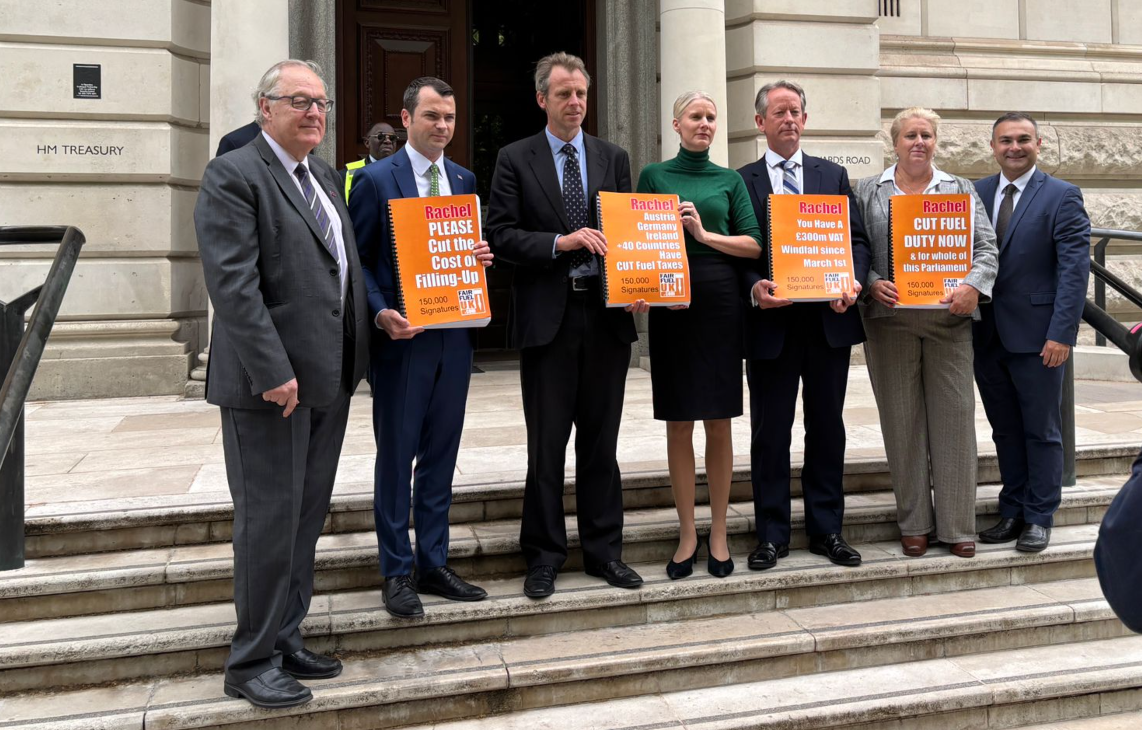
Under considerable pressure from my 16-year-old FairFuelUK
Campaign and the delivery of a 150,000-signature petition, initially turned
away by a Treasury jobsworth but successfully delivered by 9 Tory MPs to the
Chancellor's Parliamentary Office, the Chancellor reluctantly extended Rishi
Sunak’s 5p per litre fuel duty cut until the end of 2026. Whoop-de-doo!
UK petrol prices remain above the EU average, with diesel,
the commercial heartbeat of any economy, even higher. The UK average petrol
price at the time of this article is 159p per litre, and diesel is 190p. Petrol
is 20% higher than it was when the Iran Crisis hit us, and diesel is a massive
33% higher.
In context, Malta’s petrol price is 47p per litre cheaper
than the UK's forecourt price. Germany’s diesel is 19p per litre lower than the
UK’s, and Poland’s is a staggering 53p cheaper.
UK fuel prices have always been among the highest in the
world, driven by high, less diesel-favourable taxation and global oil
movements.
However, maintaining the 2022 Budget 5p cut has provided meaningful
relief, even though filling up today still leaves the UK in a higher-tax
position than many of its peers, who reacted swiftly in 2026 by implementing
fresh cuts or caps.
In summary, I will continue to try to engage with the
Treasury and Labour’s front bench to show them, for the 17th year, that
high pump prices, due mainly to high fuel levies, raise transport and
production costs, feed inflation, and reduce household disposable income and
spending, particularly for lower- to moderate-income, car-dependent households.
Lower transport costs can support economic activity by
freeing up household and business spending and reducing input costs.
Independent evidence shows that fuel price shocks slow growth and hit
vulnerable groups hardest.
It’s time for a 20-year-long-term road user strategy
that not only protects the economy from recession but also puts drivers at the
centre of any economic growth plan.
And by the way, Net Zero must be scrapped, and the UK must
become self-sufficient in energy supply, which means we must ‘drill, baby,
drill’. And we must start right now before the UK descends into economic
oblivion!
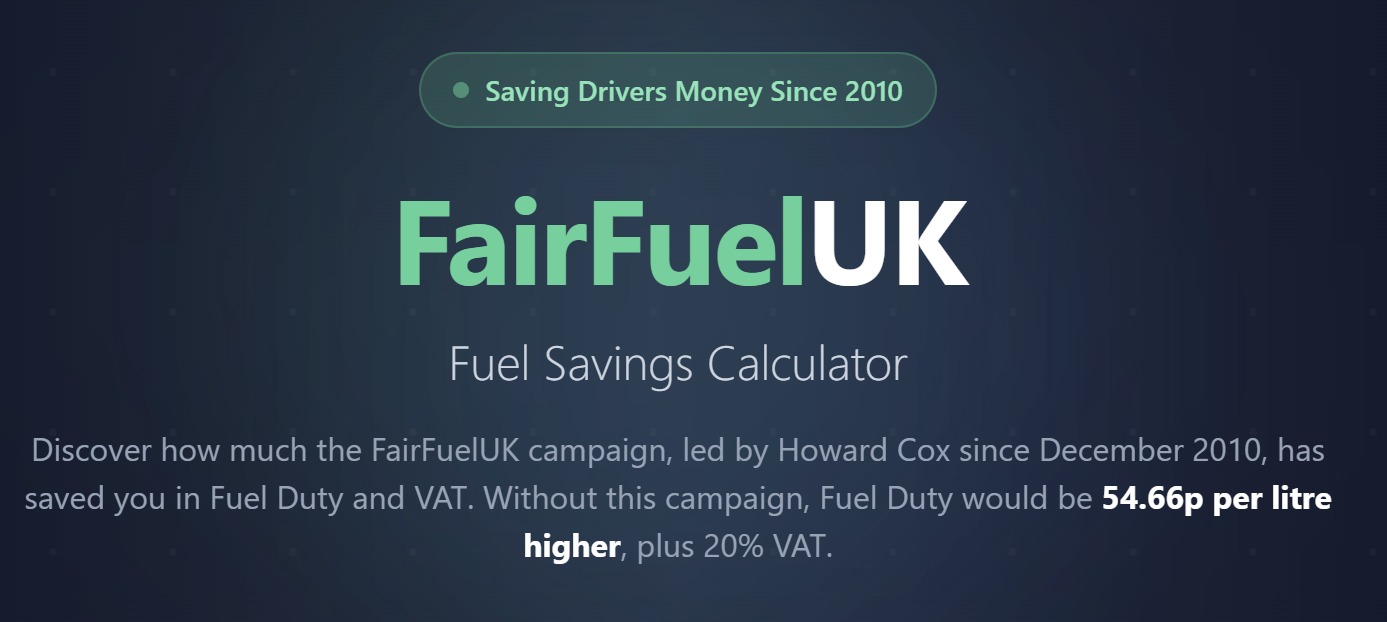
Thanks mainly to FairFuelUK, fuel duty has been frozen for
16 years and remains at its current level, which includes a temporary 5p cut.
Some armchair experts who despise supporting the UK’s 37 million drivers argue
that restoring or unfreezing fuel duty could generate more than £3 billion a
year. Utter nonsense!
The freeze on this regressive tax since 2011 means that
drivers have spent a larger portion of their disposable income, if any, in the
economy, and businesses have remained solvent due to lower-than-expected
transport costs.
Had the fuel price escalator been strictly adhered to, the UK
would now be facing a deep recession. It is now close to that situation.
No other tax exerts such a profound influence on economic
growth, inflation, employment, and business investment as the significant tax
on filling up at the pumps. Every part of our nation relies on road transport
for construction, small trade contractors, food, clothing, internet deliveries,
postal services, medical support, family cohesion, community interaction, and
mental well-being.
Well thanks to you we stopped it happening AGAIN !
I will continue to fight hard and push Rachel Reeves to implement a sensible
fiscal policy by incentivising lower transport costs through keeping Fuel Duty
frozen for the duration of this Parliament. Additionally, I will ensure that FairFuelUK’s PumpWatch is fully operational to prevent opportunistic
profiteering at the pumps.
Howard Cox, Founder of FairFuelUK

1. ....Cut fuel duty big, to stimulate the economy, reduce inflation, increase consumer spending & generate other taxes from the resultant impact of lowering this regressive tax

Ensure our PumpWatch programme launched in 2023, that the CMA backed, is re-introduced with teeth to make petrol & diesel pricing at the pumps fair, honest & transparent

Scrap the 2030 un-consulted and needless ban on new petrol/diesel car sales. What's the point of bankrupting the economy? When the virtue signalling 2030, Diesel/ Petrol Ban will cost at least 5 times the alleged environmental benefits. It's fiscal insanity!

Stop the continuing cash grabbing vitriolic myopic local authority warfare on UK's 37m drivers (These include ULEZs, LTNs, 15 Mins Localities, Cycle Lanes that cause congestion etc)

Recognise motorists are not just cash cows to be demonised by politicians & much of the ultra left wing media, but instead are the essential social & commercial heartbeat of our economy. They must not be used as an excuse to allegedly improve the environment.

There is no scientific evidence to suggest that any increase in CO2 is linked to global warming. And that mankind cannot make any difference to climate change.